

Account-led platform entry
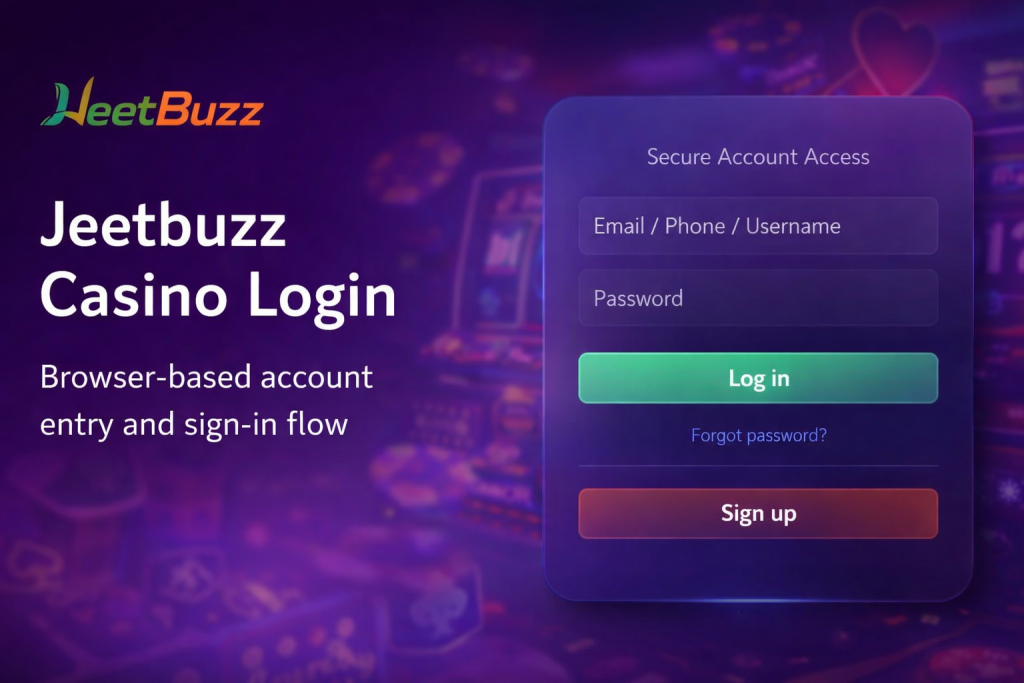
Jeetbuzz Casino login functions as the entry point into the account-controlled layer of the platform. It is not part of the promotional surface and does not attempt to influence user behaviour. Instead, it connects an existing account with the active session, restoring access to balance visibility, saved settings, and game continuity.
For Bangladesh users, login expectations are usually direct: open the platform, enter credentials, and continue without friction. A properly structured login flow reflects this by keeping the interface minimal, readable, and stable across devices. The goal is not to attract attention but to reduce uncertainty.
The login layer sits between the public casino interface and the account environment. Until authentication is completed, the platform remains in a limited-access state. After successful login, the system restores account context, including wallet state, session permissions, and navigation continuity.
What the login page actually does
The login page performs a strictly operational role. It validates credentials, confirms identity, and grants access to the account environment. It does not affect game mechanics, RTP behaviour, or session outcomes.
This distinction matters. Login is often misunderstood as part of the “experience layer,” but in reality it belongs to the infrastructure layer. Its function is to ensure that access is controlled, consistent, and secure.
Once authenticated, the system reconnects the user with previously stored account data. This includes balance tracking, transaction history, and gameplay access. The process is deterministic: the same credentials produce the same access state, without variability.
Browser-based access and session continuity
Jeetbuzz Casino login is typically accessed through a browser environment. This creates a unified entry model across desktop and mobile devices. Instead of separate login systems, the platform relies on a single session logic that adapts to screen size and device type.
Session continuity is a key part of this model. When a user logs in, the platform establishes a session that remains active until logout, timeout, or security interruption. This session allows seamless movement between sections such as games, wallet, and account settings.
From a usability perspective, the login form must remain readable across all devices. Fields should be clearly visible, input behaviour predictable, and transitions between states smooth. Poorly structured login forms introduce friction, while well-designed ones become almost invisible to the user.
Login as a structural layer, not a feature
In operator-level platforms, login is treated as a structural component rather than a feature. It does not compete for attention with bonuses or games. Its value comes from reliability, clarity, and consistency.
A stable login layer reduces errors, prevents confusion, and supports long-term platform trust. It also creates a clear boundary between anonymous browsing and authenticated interaction.
This separation is important. Before login, the user interacts with the platform in a limited way. After login, the system unlocks full account functionality. The transition between these two states should be predictable and transparent.
Login methods and credential structure
Jeetbuzz Casino login is built around a small set of credential paths rather than a wide mix of entry options. This keeps the access layer predictable and reduces input errors. In most cases, the platform allows login through a primary identifier such as email, phone number, or username, paired with a password.
The system does not treat these identifiers differently at the logic level. They all point to the same account record. The difference exists only in how the user prefers to access the account. This design choice improves usability without introducing additional complexity into the authentication process.
From a structural perspective, the login flow consists of three steps: credential input, validation, and session creation. If the credentials match the stored account data, the system opens a session and restores access. If not, the system blocks entry and may trigger additional checks depending on the number of failed attempts.
Credential validation and session behaviour
Credential validation is handled deterministically. The platform compares the entered data with stored account records. There is no adaptive behaviour or probability-based decision-making. Either the credentials match, or they do not.
After successful validation, the system creates an active session. This session acts as a temporary access layer that allows navigation across the platform. It persists until one of three events occurs: manual logout, session timeout, or security interruption.
Session persistence may vary slightly depending on the device. Mobile sessions often remain active longer due to continuous use patterns, while desktop sessions may expire faster if inactive. This is a usability adjustment, not a change in security logic.
Login methods overview
Login Methods
| Method | Credential Type | Use Case | Stability |
|---|---|---|---|
| Email login | Email + password | Primary access for most users | High |
| Phone number login | Phone + password / OTP | Mobile-first access in Bangladesh | High |
| Username login | Username + password | Legacy or manual account setups | Medium |
| Saved session | Stored browser session | Quick re-entry without full login | Conditional |
| Restricted access retry | Credential + verification | Triggered after failed attempts | Controlled |
Session limits and security checks
Login attempts are monitored at a basic level to prevent misuse. Repeated failed attempts may trigger temporary restrictions or additional verification steps. These measures are not visible in normal usage but become active when behaviour deviates from expected patterns.
Importantly, these checks do not interact with gameplay systems. They operate entirely within the access layer. Their purpose is to protect account integrity, not to influence the user experience beyond login.
The login system remains separate from financial logic, bonus systems, and game engines. This separation ensures that access control does not interfere with how the platform functions once the user is inside the account environment.
Password recovery and interrupted access
A login system is only useful when it supports both successful entry and controlled recovery. On Jeetbuzz Casino, the recovery layer matters because access interruptions are common across real usage conditions. Users forget passwords, switch devices, clear browsers, mistype credentials, or return after a long inactive period. A well-built login page does not treat these cases as exceptions. It treats them as part of the standard account access model.
Recovery should remain separate from promotional mechanics. It is not a conversion tool and it should not be framed as one. Its role is to restore account access through identity-confirmation steps that are clear, limited, and readable on both desktop and mobile screens. If that process is too vague, players lose trust in the platform. If it is too aggressive, it becomes frustrating. The correct balance is operational clarity.
Forgot password flow and reset logic
The most common interruption point is a forgotten password. In product terms, this does not mean the account is lost. It means the password layer can no longer validate the stored identity reference. The platform then moves the user from the login path into the recovery path.
This recovery path usually follows a fixed order. First, the user provides the original account identifier, such as phone number, email, or username-linked contact route. Next, the platform sends a recovery code or reset instruction to that linked channel. Then the user confirms the request and creates a new password. After that, the old password stops working and the new one becomes the active credential.
The important point is that password reset changes the access key, not the account structure itself. It does not alter wallet balances, game history, bonus state, or previous transaction records. It only replaces the credential needed to re-enter the same account environment.
Verification prompts and temporary login blocks
Not every failed login attempt means the password is wrong. Sometimes the platform interrupts access because the surrounding session context looks unusual. That can include repeated incorrect attempts, a new device, a changed browser environment, an unexpected IP pattern, or a session collision where multiple access events happen too close together.
When this happens, Jeetbuzz-style login logic should move into controlled verification rather than silent denial. In other words, the system should tell the user what type of step is needed next. This could be a reset prompt, a one-time code, or a short waiting period before another attempt. The goal is not to punish access. The goal is to keep the identity layer stable.
From a trust perspective, transparent interruption logic is better than generic failure messages. A player can accept a verification step more easily when the reason is understandable. Unclear barriers make the login page feel unreliable even when the underlying security model is functioning correctly.
Login state model
Locked attempts and access continuity
A temporary login block does not mean the account has been deleted or changed. In most cases, it means the system has paused entry until the user proves continuity of identity. That distinction is important for reducing confusion. The account remains the same; only the access route is temporarily restricted.
This also means recovery is not the same as re-registration. A user should not create a second account simply because the first one is temporarily inaccessible. The correct path is to restore the existing account through the login recovery flow. That keeps wallet history, prior settings, and account continuity intact.
Login interruption does not affect gaming logic
It is also worth stating clearly that password resets, OTP prompts, and access interruptions do not influence gameplay parameters. They do not change RTP. They do not change RNG behaviour. They do not make outcomes more or less favourable. They do not alter volatility distribution.
RTP remains a long-term statistical model at game level, not at login level. A short session after recovery is still just a short session. RNG remains independent and memoryless regardless of whether the user logged in normally, retried access, or completed a password reset. Recovery restores access to the account. It does not modify the mathematical structure of the games inside the platform.
Mobile login and cross-device usability
Jeetbuzz Casino login is expected to behave consistently across desktop and mobile environments, but the way users interact with the form changes depending on the device. In Bangladesh, a large share of access happens through mobile browsers, which means the login interface must prioritise readability, input clarity, and minimal friction on smaller screens.
On desktop, login is typically part of a wider layout. The user sees more surrounding context, and navigation is distributed across the page. On mobile, the login form becomes the central element. Fields must be clearly spaced, buttons easy to tap, and feedback immediate. Any ambiguity in input fields or validation messages becomes more noticeable on smaller screens.
The platform does not change its logic between devices. The same credentials, validation steps, and session rules apply everywhere. What changes is only the presentation layer. A strong login design adapts visually without altering how the system works underneath.
Browser-first access in Bangladesh context
Because Jeetbuzz operates primarily through browser access, login does not depend on a dedicated application. This simplifies entry for users who switch between devices or prefer not to install apps. A browser-based login also reduces fragmentation, since there is a single access model instead of multiple platform-specific variations.
In practice, this means a user can start a session on mobile and continue on desktop, or наоборот, without creating a new account or changing credentials. The login system acts as a consistent gateway regardless of device.
However, session persistence may behave slightly differently depending on the browser. Mobile browsers often keep sessions active longer due to background usage patterns, while desktop browsers may expire sessions faster when inactive. This is a usability adjustment, not a change in security logic.
Device behaviour and session expectations
The login system is designed to handle multiple access patterns. Some users log in frequently and expect quick re-entry. Others log in occasionally and rely more on recovery or saved sessions. The platform accommodates both by allowing standard login, session continuation, and controlled revalidation when needed.
Device switching is treated as a normal behaviour, not as an exception. When a user logs in from a new device, the system may require additional confirmation. This is not a restriction but a consistency check to ensure that the account remains linked to the same user.
From a UX perspective, the goal is predictability. The user should understand what happens after login, how long the session lasts, and what to expect when returning after inactivity.
Cross-device login behaviour overview
Device Login Behaviour
| Device Type | Login Behaviour | Session Pattern | UX Notes |
|---|---|---|---|
| Mobile browser | Single-column login, touch input | Longer active sessions | Optimised for quick re-entry |
| Desktop | Inline or modal login form | Session may expire faster | More visible navigation context |
| Tablet | Hybrid layout between mobile and desktop | Moderate session persistence | Balanced input spacing |
| Cross-device usage | Same credentials across devices | Session may require revalidation | Identity confirmation possible |
| New device login | Standard login + verification step | Session created after confirmation | Security-driven check |
Readability and input clarity
On mobile devices, small design issues become larger problems. If input fields are too close, labels unclear, or buttons слишком small, the login process slows down. A well-designed login page avoids these issues by prioritising spacing, contrast, and clear feedback.
Error handling also needs to be readable. Instead of vague messages, the system should indicate whether the issue is related to credentials, session state, or verification. This reduces repeated failed attempts and improves overall usability.
Consistency across devices builds trust. When the login behaves the same way every time, regardless of screen size, users do not need to re-learn the interface.
Responsible access model and platform trust
Login is often misunderstood as part of the “experience layer,” but in an operator-level platform it belongs to the access control layer. Its purpose is to connect identity with account data, not to influence how the platform behaves after entry. This distinction matters because it defines what login can and cannot do.
A successful login restores access. It does not improve outcomes, increase probabilities, or modify how games function. The platform separates access logic from game logic. This separation is what keeps the system predictable and stable over time.
From a trust perspective, the login page should feel neutral. It should not create expectations, suggest outcomes, or imply advantages. Its role is to provide a clear path into the account environment and maintain that path consistently across sessions.
What login does not influence
Once a user is inside the platform, gameplay operates under its own independent systems. These systems are not aware of how the user logged in, how many attempts were made, or whether a recovery flow was used.
RTP remains a long-term statistical model defined at the game level. It reflects expected return over extended play, not short sessions. Logging in, logging out, or resetting a password does not change this model.
RNG operates independently and is memoryless. Each outcome is generated without reference to previous results or login behaviour. There are no “corrections,” “compensations,” or adjustments tied to account access.
Volatility describes how outcomes are distributed over time. It is not affected by login frequency, device type, or session interruptions. It remains a structural property of the game itself.
Wagering, when present, functions as a release condition for bonus-related funds. It measures eligible staking volume. It is not a progression system and is not connected to login behaviour.
Demo modes allow exploration of game mechanics. They are separate from real account sessions and do not predict future outcomes.
Access control layers
Separation between access and gameplay
The platform is structured in layers. Login sits at the top as the access layer. Below it is the account layer, where wallet and user data are managed. The game layer exists independently beneath both.
This layered structure ensures that changes in one part of the system do not affect another. Logging in does not change the wallet logic. Wallet actions do not change RNG. Game outcomes do not depend on access behaviour.
That separation is what defines a stable casino platform. It prevents misconceptions and removes the idea that user actions outside gameplay can influence results.
Trust through consistency
A reliable login system builds trust not by promising anything, but by behaving consistently. The same credentials always lead to the same account. The same recovery flow always restores access in the same way. The same session rules apply across devices.
Over time, this consistency becomes more important than any visual design element. Users stop thinking about login as a process and start seeing it as a stable gateway. That is the intended outcome of a well-structured access system.